
Kavitha Kuruganti v. PepsiCo India Holdings Pvt. Ltd. | 2026 INSC 811 | 5 August 2026
What the case was about
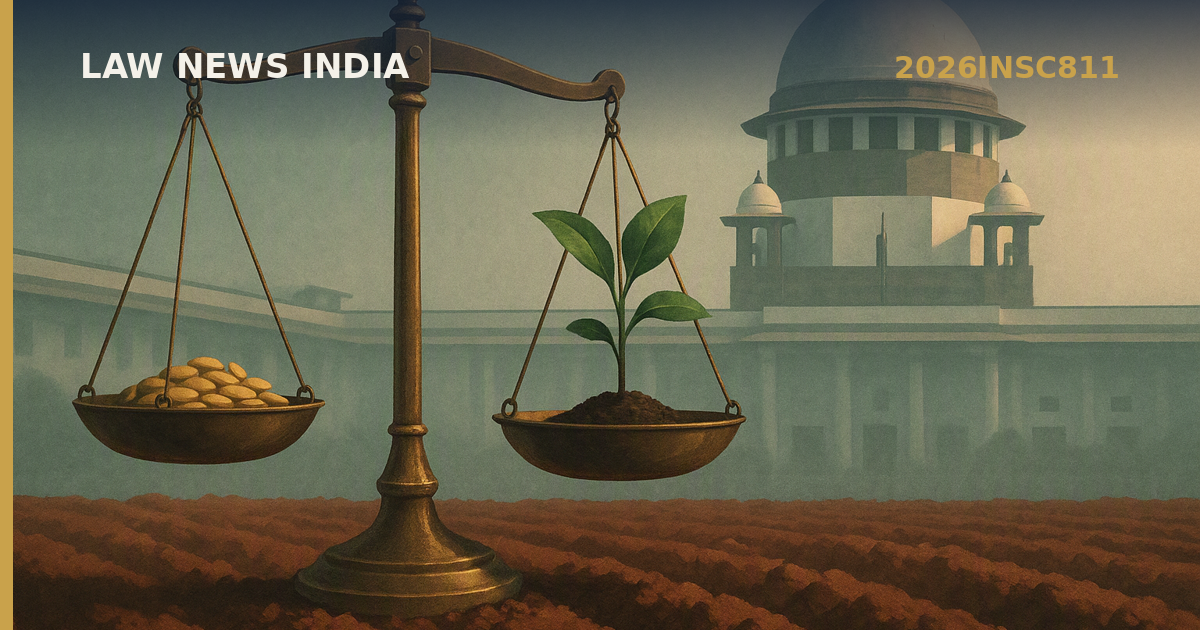
This case turned on the balance between corporate plant-breeding rights and traditional farmers’ freedoms under the Protection of Plant Varieties and Farmers’ Rights Act, 2001 (PPVFRA). The statute gives breeders exclusive rights over new plant varieties, but it also shields farmers from certain infringement claims and permits the cancellation—or revocation—of a registration if its continuation proves prejudicial to the public interest. Activist Kavitha Kuruganti challenged PepsiCo India Holdings’ registration of the potato variety FL 2027, arguing that the company’s infringement lawsuits against individual farmers amounted to intimidation that justified stripping the company of its statutory protection. The Supreme Court was asked whether the mere act of suing farmers could itself be treated as conduct warranting revocation.
The key facts
PepsiCo applied to register FL 2027 as a new variety under the PPVFRA, indicating that its first commercial sale occurred on 17 December 2009 and relying on an assignment deed dated 26 September 2003 from the original breeder to a United States affiliate of the company. After the Protection of Plant Varieties and Farmers’ Rights Authority registered the variety, Kuruganti—canvassing the rights of individual farmers—filed a petition for revocation under Section 34 of the Act. She contended that PepsiCo had filed multiple infringement suits against farmers, and that this wave of litigation was either vexatious or contrary to public interest within the meaning of Section 34(h). She placed particular reliance on Section 39(1)(iv), which preserves a farmer’s right to save, use, sow, resow, exchange, share, or sell farm produce including seed of a protected variety, provided the farmer does not sell branded seed (para 4). The Authority granted the revocation petition. PepsiCo challenged the order before the High Court, where a learned Single Judge delivered a split verdict. Both parties then appealed to the Division Bench, whose common judgment was ultimately challenged before the Supreme Court.
The questions before the Court
Two legal questions framed the dispute. First, had the High Court failed to consider the applicability of Section 39(1)(iv) and the public-interest inquiry under Section 34(h), as the petitioner contended? Second, could the filing of infringement suits against individual farmers be branded as vexatious or predatory conduct prejudicial to the public interest, thereby warranting the extreme remedy of revoking the variety registration under Section 34(h)? The Court therefore had to decide whether seeking legal redress for infringement is, by itself, an abuse of the statutory scheme, or whether it falls within the ordinary rights of a registered breeder.
What the Court decided and why
Dismissing the Special Leave Petitions, a Bench of Justice J.B. Pardiwala and Justice K. Vinod Chandran held that the Division Bench had already squarely addressed both Section 39(1)(iv) and the Section 34(h) public-interest plea, contrary to the petitioner’s submission.
On the central issue of vexatious litigation, the Court endorsed the High Court’s finding that there was nothing on record to establish that the infringement suits were predatory. It ruled that the filing of suits for the protection of rights conferred under the statute cannot, per se, be held intimidatory or vexatious (para 6). Consequently, the mere institution of infringement proceedings against farmers did not, without more, amount to conduct prejudicial to the public interest capable of triggering Section 34(h). The Court added that if any individual suit was genuinely vexatious, that allegation would have to be raised and proved at the appropriate stage before the appropriate forum, rather than being used as a lever to cancel the underlying registration (para 6).
At the same time, the Court preserved the position of individual farmers. It clarified that any farmer who claims the benefit of Section 39(1)(iv) is fully entitled to raise that statutory protection and prove it as a defence in the actual infringement proceedings initiated by PepsiCo (para 7). However, the Court made it clear that it could not restrain the registered breeder from pursuing legal remedies if its rights are infringed (para 7).
Reiterating that it found no reason to interfere with the Division Bench’s judgment, the Court disposed of the petitions accordingly (para 8).
Why it matters
The judgment provides important clarity on how India’s specialised plant-variety regime mediates between the commercial interests of breeders and the livelihood interests of farmers. By holding that enforcement of statutory rights through court action is not inherently an abuse of those rights, the Court has reinforced that revocation under Section 34(h) is a severe remedy requiring proof of genuine prejudice to the public interest beyond the mere fact of litigation. This prevents variety registrations from being cancelled simply because the owner chooses to defend its intellectual property against alleged infringers.
Equally significant is the Court’s insistence that farmers are not left without protection. By affirming that Section 39(1)(iv) can be raised and proved as a defence in individual infringement suits, the ruling channels farmer grievances into the specific cases where they arise, rather than allowing broad, pre-emptive strikes against the registration itself. The decision therefore preserves both the breeder’s statutory remedies and the farmer’s statutory shield, directing each to its proper legal forum.
For India’s agricultural sector, the ruling is a reminder that the PPVFRA creates a statutory compromise: breeders obtain exclusive rights over new varieties to encourage innovation, but farmers retain defined freedoms to save and exchange seed. Where those boundaries are contested, the Supreme Court has indicated that the contest must be fought case by case in infringement proceedings, with farmers free to assert their statutory defences, rather than by using revocation petitions to unwind the registration altogether. Future petitioners seeking revocation on public-interest grounds will therefore need to demonstrate concrete prejudice—such as evidence of systemic harassment or anticompetitive harm—that goes well beyond the normal assertion of legal rights.