
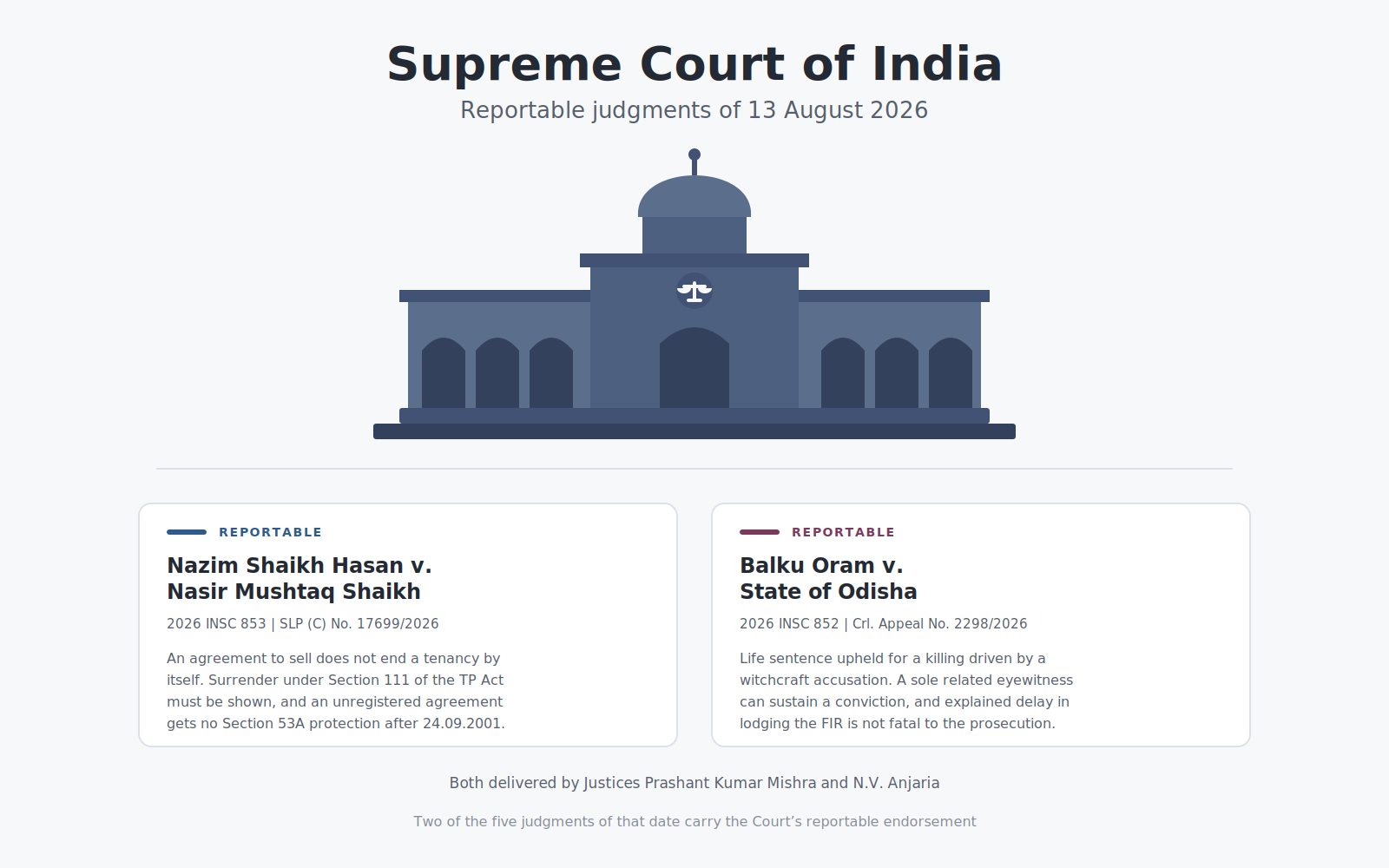
The Supreme Court of India delivered five judgments on 13 August 2026. Only two carry the Court’s REPORTABLE endorsement — 2026 INSC 852 and 2026 INSC 853 — and both come from the same Bench of Justice Prashant Kumar Mishra and Justice N.V. Anjaria. One settles a question that recurs in every rent-control docket in the country; the other affirms a life sentence for a killing driven by an accusation of witchcraft. This digest is drawn from the judgment texts themselves.
1. Does an agreement to sell end a tenancy? Supreme Court answers in Nazim Shaikh Hasan v. Nasir Mushtaq Shaikh
Citation: 2026 INSC 853 | Case: SLP (C) No. 17699 of 2026 | Bench: Prashant Kumar Mishra and N.V. Anjaria JJ | Date: 13 August 2026
Facts
A 200 sq ft ground-floor shop at Kondhwa Khurd, Pune was let to the tenant at ₹1,500 a month. While the tenancy subsisted, the landlady agreed to sell him the shop, and an agreement to sell dated 21 September 2004 was executed for ₹1,90,000. The tenant paid ₹40,000 in cash, with ₹1,50,000 to follow within three months, contingent on a bank loan; the agreement expressly provided that if the loan was not sanctioned in time, the agreement stood cancelled, the ₹40,000 would be refunded and possession of the shop handed back. The sale never fructified. The landlady later sued for possession in Civil Suit No. 384/2010 on grounds of default, change of user and bona fide need. The Small Causes Court decreed the suit on 19 September 2015, the First Appellate Court affirmed on 24 November 2023, and the Bombay High Court dismissed the civil revision on 1 April 2026.
Question of law
Whether the execution of an agreement to sell by a landlord in favour of his tenant, coupled with receipt of part consideration, terminates the landlord-tenant relationship and substitutes the rights and obligations of vendor and vendee.
Held
No — not by itself. The Court distinguished R. Kanthimathi v. Beatrice Xavier (2000) 9 SCC 339, on which the tenant relied, as a decision on its own peculiar facts: there the agreement expressly recited that the property “has already been surrendered to your possession”, and ₹20,000 of a ₹25,000 consideration had been paid, leaving only ₹5,000 at registration. Here, by contrast, the recitals contained no stipulation that possession would thereafter be referable to the agreement, no cessation of the obligation to pay rent, and nothing evincing an intention to alter the subsisting relationship.
The Court then worked through surrender under Section 111 of the Transfer of Property Act, 1882, drawing on Shah Mathuradas Maganlal & Co. v. Nagappa Shankarappa Malage (1976) 3 SCC 660 and Vayyaeti Srinivasarao v. Gaineedi Jagajyothi, and distilled four propositions:
- Mere execution of an agreement to sell between landlord and tenant does not ipso facto determine the tenancy.
- The lease ends only where the terms of the agreement, or unequivocal conduct inconsistent with continuance of the tenancy, disclose express surrender under Section 111(e) or implied surrender under Section 111(f).
- Continued possession by a tenant after an agreement to sell is not part performance under Section 53A unless that possession is shown to flow directly from the agreement; it is only where a person is inducted into possession for the first time after the contract that possession is strong evidence of having changed character.
- An agreement to sell confers no title or interest, following Suraj Lamp and Industries (2) v. State of Haryana (2012) 1 SCC 656 — transfer of immovable property requires a registered conveyance.
Two further points sealed the outcome. First, Section 17(1A) of the Registration Act, 1908, inserted with effect from 24 September 2001, provides that a contract to transfer for the purposes of Section 53A must be registered, failing which it has no effect for Section 53A at all. The agreement here was executed on 21 September 2004 and was admittedly unregistered, so the shield was unavailable regardless of the facts — a conclusion reaffirmed from Ameer Minhaj v. Dierdre Elizabeth (Wright) Issar (2018) 7 SCC 639. Impounding the document for deficient stamp duty would not have cured non-registration. Second, the tenant had never filed a suit for specific performance, conduct the Court read as militating against his claim that the relationship had become that of vendor and vendee. The SLP was dismissed.
Why this judgment matters
Tenants facing eviction routinely plead an abandoned agreement to sell as having converted them into intending purchasers, thereby ousting the jurisdiction of the Small Causes Court. This judgment supplies a structured test for that plea and makes clear that the R. Kanthimathi line does not lay down a general rule. The Section 17(1A) holding is the practical trap: for any agreement to sell executed on or after 24 September 2001, non-registration is by itself fatal to a Section 53A defence, however strong the facts.
2. Witch-hunting killing: Supreme Court upholds life sentence in Balku Oram v. State of Odisha
Citation: 2026 INSC 852 | Case: Criminal Appeal No. 2298 of 2026 | Bench: Prashant Kumar Mishra and N.V. Anjaria JJ | Date: 13 August 2026
The judgment opens with Dr B.R. Ambedkar on a just society being one in which the ascending sense of reverence and the descending sense of contempt dissolve into compassion.
Facts
On 17 February 1998 the youngest daughter of one Manobodha Naik died in village Gundibali Luhakera, PS Sector-15, Rourkela, District Sundargarh. His family attributed the death to witchcraft practised by Puni Naik. The appellant and a co-accused dragged Puni Naik from her house, took her near Manobodha Naik’s house and assaulted her with a lathi. She died in the early hours of 18 February 1998. Her daughter, PW-3, then aged 15 or 16, witnessed the assault. She lodged a written complaint at 11 a.m. on 18 February, and FIR No. 19/1998 followed under Section 302 read with Section 34 IPC. Nine prosecution witnesses were examined and none for the defence. The trial court convicted on PW-3’s testimony and imposed rigorous imprisonment for life; the Orissa High Court affirmed on 29 September 2022.
Questions of law
Whether a conviction can rest on the sole testimony of a related eyewitness without independent corroboration; whether a delay of about sixteen hours in lodging the FIR was fatal; and whether the offence fell under Section 304 Part I or Part II on the plea of grave and sudden provocation.
Held
Conviction affirmed on all three counts. Prefacing its analysis with the limits on interference with concurrent findings under Article 136 as set out in Shahaja alias Shahajan Ismail Mohd. Shaikh v. State of Maharashtra (2023) 12 SCC 558, the Court found no exceptional circumstance.
On the sole witness, PW-3 remained unshaken in chief and in cross-examination on the central fact that the appellant and co-accused inflicted the fatal assault. Direct ocular evidence that is natural, cogent and trustworthy is the best form of evidence, and Vadivelu Thevar v. State of Madras remains the governing authority — quality of a witness matters, not quantity, and Section 134 of the Evidence Act requires no particular number of witnesses. A few contradictions or omissions do not discard the whole testimony.
On delay, the Court applied Om Pal v. State of U.P. (2025 INSC 1262) and Ramdas v. State of Maharashtra (2007) 2 SCC 170, and explained the delay on the specific facts: a girl of 15 or 16 who had just watched her mother beaten to death would have been in shock, and she went to the police station only once her maternal uncle reached the house. It could not be expected of her to run to the police station that night.
On the Section 304 plea, grievous injuries to head, neck, chest and other vital parts manifested a clear intention to cause death, and nothing on record established any exception to Section 300.
Why this judgment matters
Beyond affirming the conviction, the Court added a section titled “Witch-hunting: an anathema to human dignity”, recording that the facts had deeply disturbed its conscience. It observed that the brutality of witch-hunting extends far beyond killing — victims, mostly women, face torture, beatings, sexual violence and social ostracisation — and that in difficult situations it becomes an easy escape to blame a woman for acts she did not commit, reflecting a prejudice that seeks scapegoats rather than solutions. Reason, it said, is the only virtue standing as a bulwark against collective irrationality, and a constitutional democracy founded on equality, fraternity and scientific temper cannot survive while such practices elude the rule of law. The Court closed by expressing the hope that the case serves as a solemn reminder that justice must prevail over superstition. Those passages, in a reportable judgment, are citable material for prosecutions under state anti-witch-hunting legislation.
Key takeaways
- An agreement to sell between landlord and tenant does not automatically terminate the tenancy; express or implied surrender under Section 111 TP Act must be shown.
- Continued possession by a sitting tenant is not part performance under Section 53A unless possession is traceable to the agreement itself.
- Any agreement to sell executed on or after 24 September 2001 must be registered, or it has no effect for Section 53A — Section 17(1A), Registration Act.
- A conviction may rest on a single related eyewitness whose testimony is cogent and unshaken.
- Delay in lodging an FIR is not fatal where satisfactorily explained; the age and circumstances of the informant are relevant.
- The Supreme Court has issued strong observations against witch-hunting as incompatible with constitutional morality.