
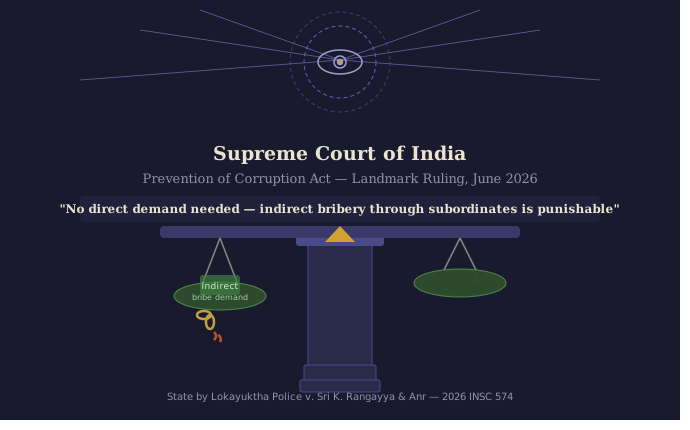
State by Lokayuktha Police v. Sri K. Rangayya & Anr, 2026 INSC 574
Summary
The Supreme Court of India ruled on June 2, 2026 that public servants can be held liable under Section 7 of the Prevention of Corruption Act even if they demand or receive a bribe indirectly through subordinates or third parties. Here is a complete summary of the landmark judgement.
What Happened?
The Supreme Court has ruled that a public servant need not personally demand or receive a bribe to attract liability under Section 7 of the Prevention of Corruption Act (PC Act), holding that attempts to obtain an undue advantage through subordinates or third parties are also punishable under the law.
The judgement, delivered by a Bench of Justices Sanjay Karol and N. Kotiswar Singh, set aside a Karnataka High Court order that had quashed an FIR against a Police Sub-Inspector accused of indirectly seeking a bribe through subordinate officials.
Background: The Karnataka Case
The case relates to allegations against Rangayya, a sub-inspector posted at Siruguppa Police Station in Karnataka. According to the complaint, police officials seized the complainant’s vehicle and registered a case against him for allegedly selling ration rice illegally. Subsequently, a bribe of ₹50,000 was allegedly demanded through a third person on the instructions of the sub-inspector.
When the complainant again met the officer on June 1, 2023, the officer directed a police constable to release the motorcycle and remarked that since the complainant had not done anything for him, he should at least “do something” for the other police personnel. Thereafter, a constable allegedly demanded ₹5,000 as a bribe, which was later negotiated down to ₹3,000 along with an additional ₹500 penalty.
Based on the complaint, the Karnataka Lokayukta Police registered an FIR under Section 7(a) of the Prevention of Corruption Act against the sub-inspector, a constable and a private individual. The Karnataka High Court later quashed the FIR, observing that there was no direct demand or acceptance of money by the police officer.
The Supreme Court’s Reasoning
The Supreme Court set aside the Karnataka High Court’s judgement, observing that the High Court had exceeded its jurisdiction under Article 226 of the Constitution by conducting a premature mini-trial and evaluating evidentiary matters at the threshold stage of a quashing petition.
The Court emphasised that under Explanation 2 to Section 7, a public servant can act as the main instrumentality in the background without receiving the bribe personally, holding that a veiled direction to “do something for those boys” constitutes a prima facie solicitation and an “attempt to obtain” an undue advantage for another person.
The Bench revived the FIR and all consequential proceedings, directing the trial court to proceed in accordance with law.
Key Legal Principle Established
The ruling clarifies a crucial point of anti-corruption law:
- The Supreme Court held that the High Court failed to properly interpret Section 7(a) read with Explanation 2 of the Prevention of Corruption Act. The Bench noted that the law covers situations where a public servant seeks an undue advantage through another person or for the benefit of another individual.
- The Supreme Court held that all three earlier judgements cited by the respondent officer — which insisted on proof of demand and acceptance — were rendered after full-fledged trials and dealt with the sufficiency of evidence required to sustain convictions, not with the threshold for registering an FIR.
Why This Judgement Matters
This ruling has significant implications for anti-corruption enforcement in India:
1. Closes a legal loophole. Senior officials can no longer escape liability simply by channelling bribe demands through subordinates or private intermediaries.
2. Broader reading of Section 7. The Prevention of Corruption Act’s Section 7, as amended, is now interpreted to include any attempt to obtain an undue advantage — even an indirect or implicit one.
3. Limits High Court powers at FIR stage. The Court reinforced that quashing an FIR requires the High Court to take the complaint at face value, without conducting what amounts to a preliminary trial.
4. Strengthens the Lokayukta’s hand. Anti-corruption bodies like the Karnataka Lokayukta can now proceed against senior officers who orchestrate bribery schemes behind the scenes.
Case Citation
State by Lokayuktha Police v. Sri K. Rangayya & Anr — 2026 INSC 574 Bench: Justice Sanjay Karol & Justice N. Kotiswar Singh Decided: June 2, 2026 Statute: Section 7(a), Prevention of Corruption Act, 1988
Tags: Supreme Court of India, Prevention of Corruption Act, Section 7, bribery, indirect demand, public servant, Karnataka Lokayukta, anti-corruption law India 2026, 2026 INSC 574