
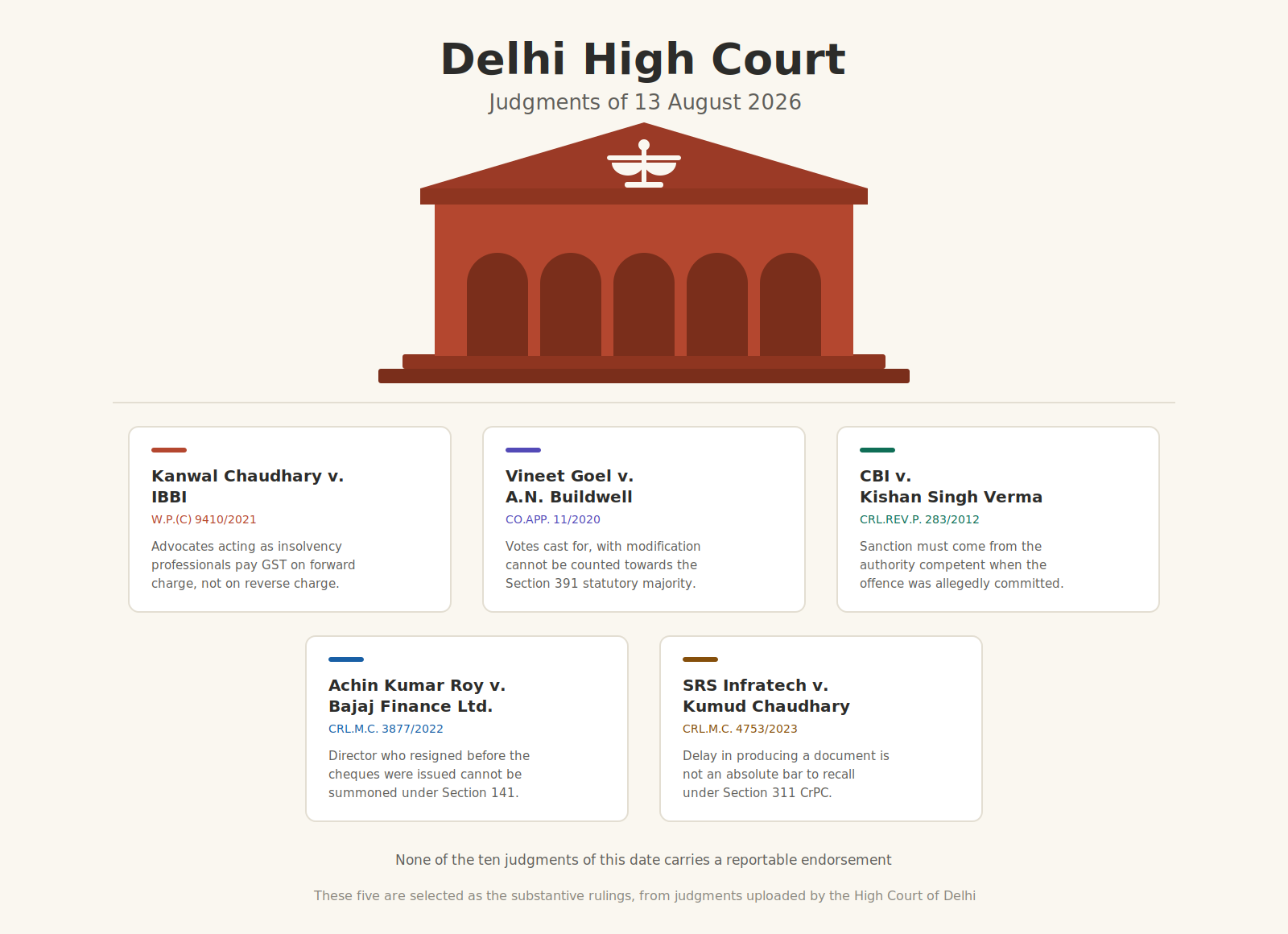
1. Advocates acting as insolvency professionals must pay GST under forward charge, not reverse charge
Case: Kanwal Chaudhary v. Insolvency and Bankruptcy Board of India | W.P.(C) 9410/2021 | Bench: Prathiba M. Singh and Shail Jain JJ | Reserved 9 July 2026, pronounced 13 August 2026
Facts
The petitioner, an advocate enrolled with the Bar Council of Delhi since 1995, registered as an insolvency professional on 27 July 2017. On 13 December 2018 the NCLT, Delhi appointed him interim resolution professional for Ireo Fiveriver Pvt. Ltd. while admitting a Section 9 application. He raised invoices in August and October 2019, and when payment was not made he pressed for his fees. He was called upon to raise GST-compliant invoices; he contended that GST, if payable, was payable by the corporate debtor on reverse charge. The NCLT referred the question to the IBBI, which held on 9 March 2021 that insolvency and receivership services are not covered by the reverse charge mechanism and directed him to furnish GST-compliant invoices. He challenged that order under Article 226.
Question of law
Whether an advocate acting as an insolvency professional is governed by the forward charge mechanism or the reverse charge mechanism for payment of GST.
Held: forward charge
The Bench structured its analysis around three questions — the mechanism applicable to advocates, that applicable to insolvency professionals, and that applicable to advocates who act as insolvency professionals.
Under Section 9(1) of the CGST Act, 2017, the default position is forward charge: the supplier includes GST in the invoice and bears the liability. Section 9(3) empowers the Government, on the GST Council’s recommendation, to notify categories where the recipient pays instead. Notification No. 13/2017-Central Tax (Rate), read with the corrigendum of 25 September 2017, brings services supplied by an individual advocate, senior advocate or firm of advocates “by way of legal services” within reverse charge, with legal service defined in Notification No. 12/2017 as advice, consultancy or assistance in any branch of law, including representational services.
The Court’s key move was to separate the service from the person rendering it. While the work of an insolvency professional falls within the broad heading of legal and accounting services, the specific service supplied is “insolvency and receivership service” — a category that Notification No. 13/2017 does not cover. The trigger for reverse charge is therefore absent. The mechanism applicable to a service rendered as an insolvency professional is the one applicable to insolvency professionals as a class, not the one applicable to advocates.
The Court issued three directions. Advocates enrolled with a Bar Council who act as insolvency professionals under the IBC are governed by the forward charge mechanism, must obtain GST registration and comply with all consequential requirements under the CGST Act and rules in the same manner as insolvency professionals as a class. This applies onlyto services rendered in the capacity of an insolvency professional and does not disturb the reverse charge mechanism that continues to govern legal services rendered by advocates in their capacity as advocates. The petitioner was directed to furnish GST-compliant invoices for his fees as interim resolution professional. The Bar Council of India’s affidavit of 6 September 2025 was recorded as reaffirming the IBBI’s position.
Why it matters
Every advocate on the IBBI register now has a clear compliance answer to a question that has produced years of uncertainty, traceable back to the interim protection granted in W.P. (C) 5709/2017 restraining coercive action against lawyers pending clarification. The practical consequence is registration and outward-supply compliance for a body of professionals who may have assumed their Bar enrolment exempted them. The carve-out is equally important: dual-hatted practitioners now operate under two different GST regimes depending on which hat they wear for a given engagement.
2. Conditional votes cannot be counted as approval: Delhi High Court sets aside A.N. Buildwell revival scheme
Case: Vineet Goel v. A.N. Buildwell Private Ltd. & Ors. and connected appeals | CO.APP. 11/2020 and batch | Bench:Anil Kshetarpal and Shail Jain JJ | Reserved 4 August 2026, pronounced 13 August 2026
Facts
A batch of company appeals challenged a Single Judge’s judgment of 17 February 2020 sanctioning a revival scheme for a company in liquidation, involving the Spire Edge and Spire Woods projects. The Chairman’s Report recorded 384 valid votes from allottees of Blocks B, C and D: 22 for the scheme without modification, 293 for the scheme with modification, 19 against without modification and 50 against with modification. The Single Judge treated 315 votes as “for”, recorded approval by over 75% of creditors present and voting, and declined to interfere on the ground that the Court cannot sit in appeal over commercial wisdom.
Question of law
Whether votes cast “for, with modification” can be aggregated with unconditional votes to make up the statutory majority under Section 391(2) of the Companies Act.
Held: no
The Division Bench accepted that a court does not sit in appeal over the commercial wisdom of a duly informed majority acting bona fide — but held that this limitation operates only after the court has satisfied itself that the statutory requirements for sanction are met. Drawing on Meghal Homes (P) Ltd. v. Shree Niwas Girni K.K. Samiti (2007) 7 SCC 753, cited in the judgment under appeal itself, the Court listed what must be examined: whether the scheme sanctioned is the scheme the requisite majority approved, whether voters had sufficient material for an informed decision, whether the class acted bona fide and fairly, whether the scheme is just, fair and reasonable to the class as a whole, whether it offends law or public policy, and, for a company in liquidation, whether the arrangement genuinely provides for revival rather than merely postponing or circumventing liquidation.
On that footing the question was anterior and narrower than commercial merit. A vote cast “for” expresses assent to the scheme as placed before the meeting; a vote cast “for, with modification” is by its description conditional on the modification. The two cannot be treated as identical without examining the nature and effect of the condition. Here the modifications went to substantive contractual and financial rights under the buyer-builder agreements — assured returns, lease commitment charges and related obligations — and were neither clerical nor inconsequential. Accept them and the arrangement assented to is one thing; reject them and it is materially different. The conditional votes could not therefore be aggregated as unqualified approval.
The appeals were allowed and the sanctioning judgment set aside, with remand to the Single Judge to examine afresh the legal effect of the votes cast “for, with modification”, the modifications attached, and the objections of individual allottees and other stakeholders under Sections 391 to 393. Any fresh or modified scheme must follow the statutory procedure including convening of meetings and furnishing material for informed decisions. The Court expressly clarified that it was not consigning the company to liquidation, not holding that the projects cannot be revived, not adjudicating individual allottee claims for refund, assured returns, penalty, interest or compensation, and not affecting any criminal proceedings or investigation.
Why it matters
Conditional voting is common in real-estate revival schemes where allottees support rescue in principle but disagree on terms. This judgment holds that the chairman’s tabulation cannot convert conditional assent into statutory approval, and that a court sanctioning a scheme must interrogate the substance of the conditions. It also draws a clean line around the “commercial wisdom” doctrine, which is frequently invoked to foreclose scrutiny that Section 391 in fact requires.
3. Sanction to prosecute must come from the authority competent at the time of the alleged offence
Case: CBI v. Kishan Singh Verma | CRL.REV.P. 283/2012 | Judge: Saurabh Banerjee J | Reserved 23 July 2026, pronounced 13 August 2026
Facts
The respondent was appointed a Junior Engineer (Class III) in the DDA on 15 February 1979, governed by the DDA (Salaries, Allowances and Conditions of Service) Regulations, 1961. On 1 March 1993 the CBI registered an FIR alleging that between 1979 and 1993 he had acquired assets of ₹18,18,875 disproportionate to known sources. Sanction to prosecute was obtained on 30 December 1994 from the Finance Member, DDA; the chargesheet under Section 13(2) read with 13(1)(e) of the Prevention of Corruption Act was filed on 10 May 1995 and charges framed on 31 October 2003. In 2010 the accused applied to drop proceedings for want of valid sanction, and the Special Judge dropped them on 18 January 2011. The CBI relied on a Gazette Notification effective 1 March 1994 recategorising Junior Engineer as a Group C post, which made the Commissioner (Pers.) the appointing and disciplinary authority — and argued that the Finance Member, being superior, was equally competent.
Question of law
Which authority is competent to sanction prosecution under Section 19 of the PC Act where service regulations were amended after the period of the alleged offence.
Held: sanction was invalid
Throughout the period 15 February 1979 to 2 March 1993, when the assets were allegedly acquired, the respondent remained governed by the 1961 DDA Regulations, under which the Vice-Chairman was the authority competent to impose all penalties including removal. Under Section 19(2) of the PC Act only the Vice-Chairman could accord sanction. The Gazette Notification of 1 March 1994 was issued afterwards and was therefore of no consequence, so its disputed validity did not need to be examined. Nor could the departmental noting of 29 December 1994, or discussions between the Vice-Chairman, the Director (Vigilance) and the Finance Member, or the fact that sanction was granted under the Vice-Chairman’s directions, cure the defect. The Court added that the trial court had left the CBI free to obtain fresh sanction, which had not been done to date, and that after fourteen years of pendency it was too late to turn the clock back. Revision dismissed.
Why it matters
Sanction is assessed against the competent authority as at the time of the alleged offence, not at the time of sanction. Prosecuting agencies cannot bridge the gap by pointing to a superior officer or to internal consultation, and a concession to obtain fresh sanction has a practical shelf life.
4. Director who resigned before cheque issuance cannot be summoned under Section 138 NI Act
Case: Achin Kumar Roy v. Bajaj Finance Ltd. | CRL.M.C. 3877/2022 and connected petitions | Judge: Saurabh Banerjee J | Decided 13 August 2026
Facts
Bajaj Finance filed complaints under Sections 138, 141 and 142 of the Negotiable Instruments Act over cheques issued by Leel Electricals Limited under an Amendatory Loan Agreement dated 12 December 2018, aggregating several crores and dishonoured in February and March 2019 for insufficient funds. The petitioner was arrayed as accused no. 3 and summoned by the MM, Dwarka Courts. He produced a certified Form DIR-12 filed under Section 168 of the Companies Act, 2013 with the MCA, backed by an MCA letter of 25 November 2024, showing that he ceased to be a director with effect from 8 January 2019 — roughly two months before the cheques were issued and dishonoured.
Held: summoning orders quashed
The Court treated Form DIR-12 as a statutory document and sterling proof of cessation. It noted pointedly that the petitioner had annexed it to his reply of 16 April 2019 to the statutory notice, before the complaints were even filed, yet the complaints were silent about it — as were the replies before the High Court. Following Pooja Ravinder Devidasani v. State of Maharashtra and Gunmala Sales (P) Ltd. v. Anu Mehta (2015) 1 SCC 103, a person who had resigned before the cheques were issued cannot be made vicariously liable under Section 141. Continuance would be wholly vexatious, and issuance of summons is a serious process not to be undertaken mechanically or without application of mind. The petitions were allowed and all four complaints quashed against the petitioner.
Why it matters
A recurring problem in cheque-dishonour practice is the blanket arraignment of every person shown as a director in stale records. This judgment confirms that MCA filings are decisive on the date of cessation, and treats a complainant’s silence about a resignation already disclosed in reply to the statutory notice as a factor supporting quashing.
5. Delay in producing a document is not an absolute bar under Section 311 CrPC
Case: SRS Infratech Pvt Ltd & Anr. v. Kumud Chaudhary & Ors. | CRL.M.C. 4753/2023 | Judge: Madhu Jain J | Decided 13 August 2026
Facts
In a Section 138 NI Act complaint concerning a ₹25 lakh loan and a loan agreement dated 16 November 2009, the original complainant died and his legal representatives were substituted. After the complainant’s witness had been examined and discharged, the accused’s statement recorded and defence evidence begun, the respondents sought to bring on record a promissory note of the same date, 16 November 2009. The Magistrate allowed recall of a witness under Section 311 CrPC on 17 October 2022 and the note was marked Ex. CW-1/7; the Additional Sessions Judge dismissed the revision on 25 March 2023. The petitioners alleged the document was forged and objected to the substantial delay in producing it.
Held: petition dismissed
The promissory note related to the same transaction, had been sought to be placed on record in February 2020, and an earlier application had been withdrawn without adjudication on merits. The delay was undoubtedly substantial and the explanation would have to withstand scrutiny at trial — but delay cannot be elevated into an absolute rule of exclusion given the express language of Section 311 and the Supreme Court’s decision in P. Chhaganlal Daga. Crucially, permitting a document into evidence is not the same as accepting it as genuine; execution and genuineness must still be proved, and the allegation of forgery remains an allegation at this stage. Interference under Section 482 would exclude the document without allowing proof and cross-examination to run their course. The Court expressly reserved all objections on execution, genuineness, admissibility and evidentiary value, vacated interim protection and directed expeditious progress.
Why it matters
A clean statement of the distinction between admitting a document into the record and accepting its contents — the answer to the common objection that late production plus an allegation of fabrication should keep a document out altogether.