
Introduction
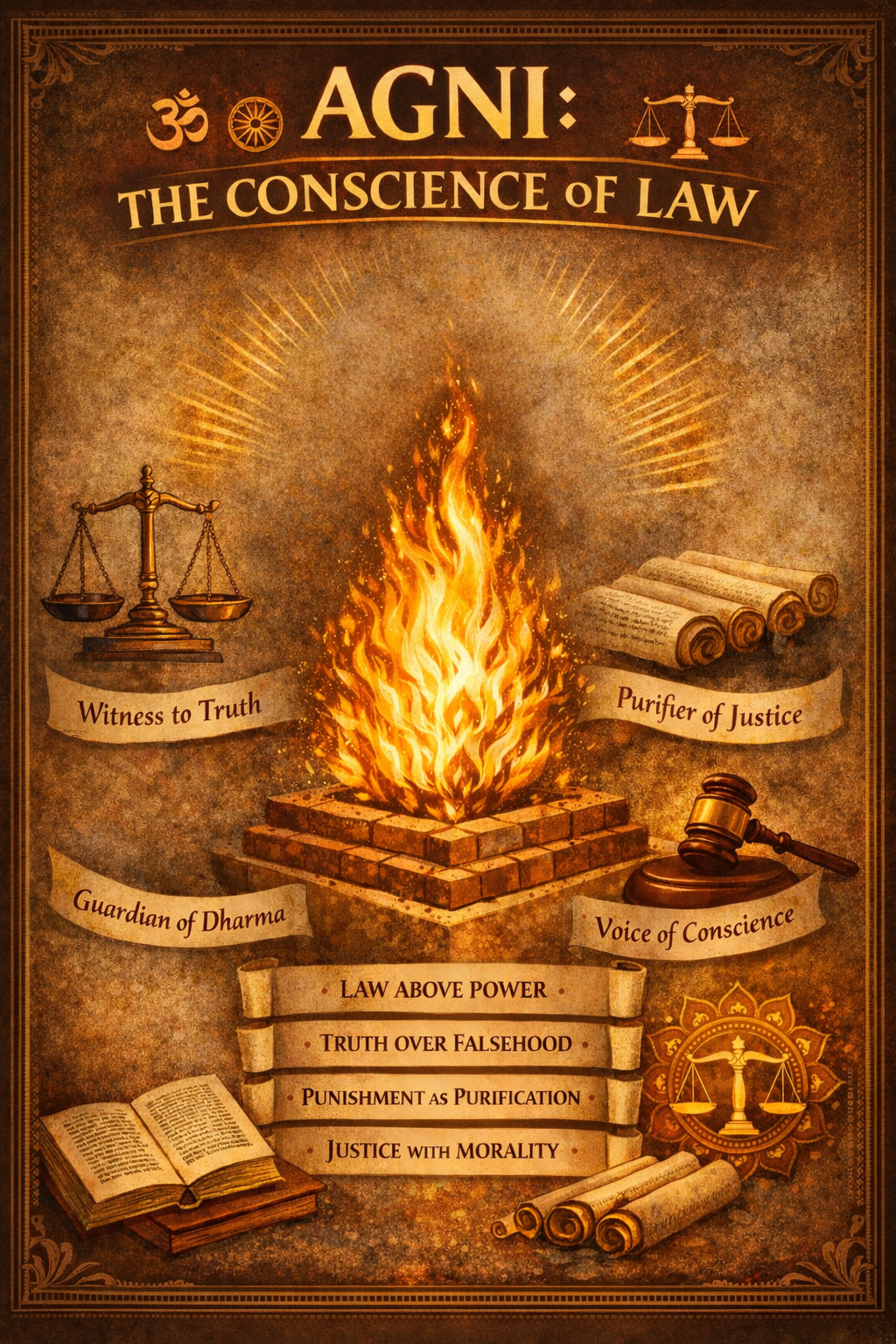
Long before written constitutions, codified statutes, or institutional courts, Indian civilisation conceived of law as a moral force, not merely an instrument of power. At the heart of this conception stood Agni—fire—not simply as a ritual element or deity, but as the conscience of law itself. Agni functioned as witness, purifier, adjudicator, and moral compass, embodying the idea that justice must ultimately answer to truth.
This article explores how Agni evolved into one of the earliest jurisprudential principles, how it shaped Hindu legal thought, and how its core ideas continue—often invisibly—to inform modern constitutional and legal reasoning.
Agni in the Vedic Worldview: More Than Fire
The Ṛg Veda opens not with a king or a god of conquest, but with Agni:
“Agniṁ īḷe purohitam”
“I invoke Agni, the priest placed in front.”
Agni is immediately positioned as mediator and officiant, standing between the human and the cosmic. In legal-philosophical terms, this makes Agni the intermediary between conduct and consequence—the bridge between action (karma) and order (ṛta).
Fire, unlike any other element, transforms whatever it touches. This transformative quality made Agni the natural symbol for justice: law was not meant merely to punish, but to purify, correct, and restore balance.
Agni as Witness: The Foundation of Legal Accountability
One of Agni’s most important juridical roles was that of sākṣī—the witness.
In early Dharmic society:
- Oaths were taken before fire
- Marriages, contracts, and vows were sanctified by Agni
- Perjury before Agni was considered a grave moral and legal violation
The underlying assumption was profound: truth cannot survive falsehood when exposed to fire. Agni did not enforce law through force, but through moral inevitability. A lie might evade human detection, but it could not escape cosmic accountability.
This idea predates modern notions of oath-taking in courts, where the emphasis remains not on fear of punishment alone, but on truth as a moral obligation.
Agni and Proof: Law Before Documents
In the absence of written evidence, early Indian jurisprudence relied on:
- Conduct (ācāra)
- Oath (śapatha)
- Divine tests (divya)
Among these, fire ordeals (agniparīkṣā) were the most misunderstood and the most restricted. They were:
- Rare
- Invoked only when human means failed
- Considered a last resort
Importantly, fire was not a tool of coercion but of divine adjudication. The underlying belief was not that fire punishes, but that truth protects.
This differs markedly from medieval European trials by ordeal, which were mechanical and later rejected. In the Indian context, Agni was bound by dharma, not cruelty.
Punishment as Purification, Not Revenge
Modern legal systems often oscillate between deterrence and retribution. Dharmic law, guided by Agni, followed a different path.
Punishment (daṇḍa) was intended to:
- Restore moral equilibrium
- Reform the offender
- Cleanse social imbalance
Fire symbolised this philosophy perfectly:
Agni burns impurity, not the essence.
Thus, even penalties (prāyaścitta) were conceived as corrective disciplines, not acts of vengeance. Justice without conscience was seen as adharma.
Comparative Perspective: Fire and Law Across Civilisations
Many civilisations invoked fire in legal contexts:
- Rome revered Vesta as the flame of the State
- Zoroastrian Iran used fire to test truth (Asha vs Druj)
- Medieval Europe practised trial by fire
What distinguishes the Indian conception is that Agni was not subservient to the State or priesthood. Agni answered only to ṛta, the cosmic order. This made law superior to power, and morality superior to authority.
Agni’s Afterlife in Modern Constitutional Thought
Modern India is constitutionally secular, yet the ethical architecture of its legal system carries Dharmic echoes.
Consider:
- Oaths taken in court
- Emphasis on constitutional morality
- Judicial insistence on truth, fairness, and due process
- The idea that law must serve justice, not convenience
When courts say that procedure is the handmaiden of justice, they unknowingly echo an ancient belief:
Law exists to reveal truth, not to obscure it.
Agni, stripped of ritual form, survives as judicial conscience.
Agni as the Conscience of Law
To call Agni the conscience of law is to recognise that:
- Law is not merely coercive power
- Justice is not merely outcome-driven
- Truth is not negotiable
Agni represents the inner fire of legality—that which judges, legislators, and citizens alike must answer to when written law falls silent.
Conclusion
Agni reminds us that the legitimacy of law does not arise from authority alone, but from moral alignment with truth. Long before constitutions spoke of justice, liberty, and equality, Agni stood as their silent guarantor.
In an age where law risks becoming procedural, politicised, or transactional, the ancient flame offers a warning and a guide:
A law without conscience may endure,
but it will never command legitimacy.
Agni, the eternal witness, still burns.
Appreciate the author to well explained the “AGNI”, the Devine power in today’s law context.
Rgds,
Ganesh Dutt Gautam
Advocate
Rajasthan High Court Jaipur Bench
+91-8824759393