
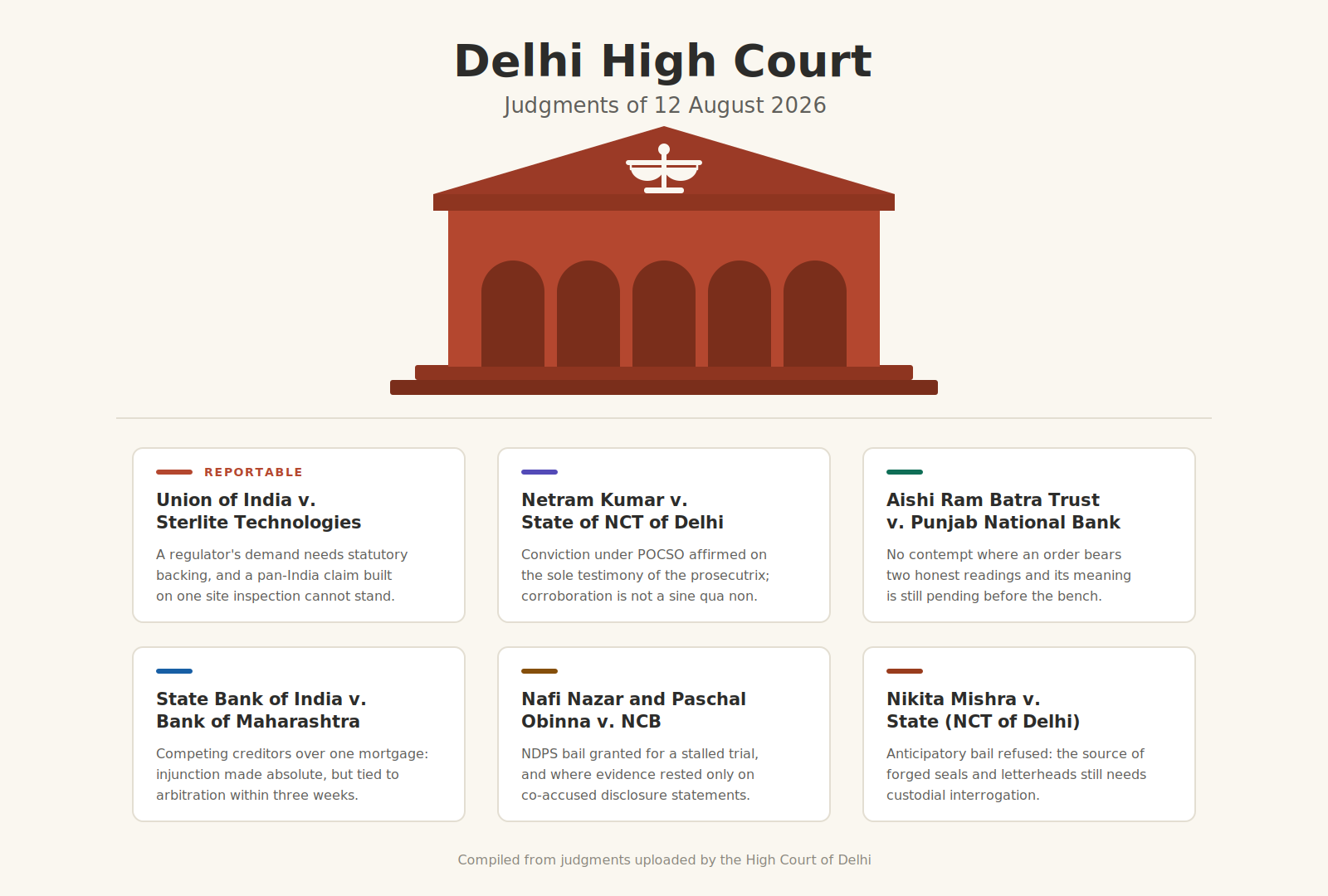
1. A nationwide demand from a single inspection
Union of India v. Sterlite Technologies Limited — O.M.P. (COMM) 395/2023 | Avneesh Jhingan J | reserved 27.07.2026, pronounced 12.08.2026 | Reportable
Subject matter. Arbitration — the scope of interference under Section 34, and whether a statutory authority can raise a damages demand without statutory backing.
Facts. The respondent held an Infrastructure Provider Category-I registration certificate from the Department of Telecommunications, permitting it to provide passive telecom infrastructure only. Through a wholly owned subsidiary it entered Master Service Agreements with telecom service providers in 2012, structured on subscriber base and revenue sharing rather than lease rentals. DoT inspected one premises at Pune on 26 February 2015; the resulting report of 12 August 2015 concluded that the respondent was selling bandwidth beyond the scope of its certificate, operating equipment through its subsidiary, and evading charges. A demand followed, extended across the whole country. The arbitrator set aside the demand notice by award dated 17 May 2023, and DoT challenged that award.
Questions of law. Whether a demand for breach of registration conditions can be sustained absent any statutory provision or contractual clause authorising it; whether liquidated damages under Section 73 of the Contract Act can be awarded without pleading and proof of actual loss; and whether the award disclosed any ground for interference under Section 34.
Findings. The demand failed at its foundation — a demand raised by a statutory authority requires statutory backing, and DoT could point to no provision of the Telegraph Act nor any clause in the registration certificate permitting damages for breach of its terms, leaving Section 73 of the Contract Act as the only route. That route also failed, since Section 73 requires both breach and proof of actual loss (or proof that actual loss cannot be established), and DoT’s statement of defence pleaded no loss at all. The Court held the arbitrator was right to call the pan-India demand pernicious: no inspection was carried out anywhere but Pune, and the inspecting team simply presumed identical activity in every other city. DoT’s argument that the arbitrator had contradicted himself on corporate separateness was rejected — the arbitrator never treated parent and subsidiary as one entity, but held that even accepting DoT’s own case, no demand could survive for the period the subsidiary’s unified licence application was pending. A 2020 letter said to contain an undertaking to pay in fact reserved legal remedies and sought the computation. Applying Prakash Atlanta, Ramesh Kumar Jain, Consolidated Construction Consortium and Sepco, the Court held the arbitrator’s view plausible and dismissed the petition.
Significance. It is the only judgment of the day the Court itself marked for reporting, and the reason is visible in the reasoning. Two propositions travel well beyond telecom: regulators cannot convert a licence breach into a monetary demand without a statutory or contractual hook, and a demand extrapolated across the country from a single site inspection has no evidentiary basis. Both are of direct use to any entity facing regulatory demands built on sample inspections.—
2. Trust reposed, trust breached
Netram Kumar v. State of NCT of Delhi — CRL.A. 573/2026 | Madhu Jain J | reserved 29.07.2026, decided 12.08.2026
Subject matter. Criminal appeal against conviction under Sections 354 and 354A IPC and Section 10 POCSO — sufficiency of the prosecutrix’s sole testimony.
Facts. The appellant, a drawing teacher, was accused by a minor student of inappropriate conduct within the school premises on several occasions. FIR 678/2016 was registered at PS Nand Nagri on 11 August 2016 and the appellant arrested the following day. The student’s statement was recorded under Section 164 CrPC on 17 August 2016. Charges were framed in November 2019; a charge under Section 21 POCSO was separately framed against the school principal for failure to report. The prosecution examined ten witnesses, the appellant led two defence witnesses, and evidence closed in 2024. The trial court convicted on 16 April 2026 and sentenced the appellant on 15 May 2026 to five years rigorous imprisonment with a fine of ₹2,000. The appeal was brought under Section 415 read with Section 528 BNSS.
Questions of law. Whether the prosecutrix’s testimony suffered from inconsistencies rendering it unsafe to rely upon; and whether conviction can rest on that testimony without corroboration.
Findings. The testimony disclosed no material inconsistency or prevarication of the kind that would make reliance unsafe. The trial court had tested it against the complaint, the Section 164 statement and the deposition, and found the core version intact — an assessment the High Court saw no reason to disturb. Applying State (NCT of Delhi) v. Pankaj Chaudhary, the Court reiterated that corroboration is not a sine qua non and a conviction can rest on the sole testimony of the prosecutrix where it inspires confidence. Conviction and sentence affirmed, and a copy directed to be sent to the trial court.
Significance. The value lies in what the Court added before parting. It recorded serious concern that a child ordinarily reposes trust in a teacher, that such trust is sacred to the relationship and carries a duty to protect rather than to breach, and that abuse of that position cannot be treated as a mere lapse of discipline or propriety. It was equally troubled that the principal was said to have told the child not to tell her parents, observing that a child who complains should never be made to feel she has done something wrong by speaking. The Court directed its remarks at institutions generally: schools must make children aware of their rights and build an environment in which both girls and boys feel able to raise anything causing them fear or discomfort. That passage is usable as institutional guidance well beyond this case.—
3. Two readings of one order
Ch. Aishi Ram Batra Public Charitable Trust v. Punjab National Bank & Ors. — CONT.CAS(C) 1043/2026 | Mini Pushkarna J | decided 12.08.2026
Subject matter. Civil contempt — whether a bank caught between competing instructions can be held in contempt of an order capable of two readings.
Facts. In a pending suit, the roster bench had directed on 29 May 2026 that the banks comply with Minutes of Meeting of the Trust’s Governing Body dated 20 and 22 December 2025. The petitioner Trust read that as requiring PNB to honour cheques signed by any two members of Group A together with one from Group B, per the KYC form on record. Respondent no. 4 read the same order differently and wrote to the bank on 1 June 2026 asking it to withhold encashment and other banking activity. A vacation bench then directed on 10 June 2026 that PNB resume normal operations and honour instruments strictly per the 22 December 2025 resolution, with the two-plus-one mandate continuing. Contempt was alleged against the bank.
Questions of law. Whether culpability attaches to a bank that receives conflicting letters from opposing parties while the meaning of the underlying order is itself disputed; and whether a vacation bench may issue directions going beyond those of the roster bench.
Findings. The order of 29 May 2026 was being interpreted in divergent and conflicted ways by both sides, and applications on the injunction and on the meaning of that order were pending before the roster bench. In those circumstances PNB, in receipt of letters from both sides, could not be faulted for how it acted, and no culpability could be attributed while interpretation remained undecided. The Court also noted a real inconsistency in the material: the Minutes named three specific representatives as authorised signatories, while the KYC form contained no such term. On the argument that the vacation bench had exceeded the roster bench, the Court declined to decide, directing that this question too be raised before the roster bench. The petition was disposed of, with all interim directions merging into the final order and the next date of 11 September 2026 cancelled.
Significance. It is a practical statement of a threshold that contempt petitions frequently blur — where the order alleged to be violated is genuinely open to two readings and the correct reading is itself sub judice, there can be no wilful disobedience, and a third party caught between the litigants cannot be made the target. The refusal to resolve the roster bench versus vacation bench question in contempt proceedings, sending it instead to the bench seized of the matter, reflects the same discipline.—
4. Two banks, one mortgage
State Bank of India v. Bank of Maharashtra & Ors. — O.M.P.(I) (COMM.) 535/2025 | Om Prakash Shukla J | decided 12.08.2026
Subject matter. Interim relief under Section 9 of the Arbitration and Conciliation Act, invoked through Section 11 of the SARFAESI Act, where two secured creditors claim the same property.
Facts. SBI advanced ₹4.5 crores to respondents 2 to 4 against a mortgage by deposit of title deeds over property no. 63, Block A, Sector 8, Dwarka. On default it issued SARFAESI notice and filed an original application before DRT-1, Delhi. It then learned that Bank of Maharashtra asserted a security interest over the same property and had issued an auction notice for 15 January 2026, with possession proposed for 5 January. SBI invoked Section 11 of the SARFAESI Act — which routes disputes between secured creditors to arbitration — and moved this Court under Section 9. By order of 23 December 2025 the Court restrained Bank of Maharashtra from taking possession or auctioning, noting that SBI held the original title deeds, that roughly ₹5 crores was outstanding, and that an auction would leave SBI remediless with loss not compensable in money. A complication surfaced at the hearing: counsel for respondent no. 3 submitted that respondent no. 3 had died in 2011, which respondent no. 4 disputed.
Questions of law. Whether interim protection should be made absolute pending arbitration between competing secured creditors, and on what conditions.
Findings. Keeping in view the objective of expeditious disposal in commercial matters, the interim order restraining possession and auction was made absolute — but conditionally. SBI must commence arbitration under Section 11 of the SARFAESI Act within three weeks, and the order is made absolute subject to that step being taken. Once the tribunal is constituted, either side may move under Section 17, and the Court’s protection continues only until the tribunal considers the prayer for interim relief. The petition was disposed of on those terms.
Significance. Section 11 of the SARFAESI Act is a lightly used provision, and this order shows the practical mechanics of using it: an inter-creditor dispute over the same secured asset is arbitrable, and Section 9 is available to freeze enforcement while that arbitration is set up. The conditional structure is the instructive part — protection is tethered to a three-week deadline to invoke arbitration and expires when the tribunal takes up interim relief, so a Section 9 order is not allowed to become an indefinite stay on a competing creditor’s enforcement.—
5. The officer who never was
Nikita Mishra v. State (NCT of Delhi) — BAIL APPLN. 2943/2026 | Girish Kathpalia J | decided 12.08.2026
Subject matter. Anticipatory bail in a forgery and cheating case turning on the need for custodial interrogation.
Facts. FIR 427/2026 of PS Seemapuri was registered on the complaint of the applicant’s father-in-law under Sections 319(2), 318(4), 336(3), 339 and 61(2) BNS. After marrying the complainant’s son, the applicant is alleged to have lived separately at Gurugram on the pretext that she had been selected as an Additional District Magistrate in Himachal Pradesh and was undergoing training. The prosecution case is that she forged a notification of appointment purportedly issued by the Chief Secretary to the Himachal Pradesh Government, along with car stickers describing her as ADM, Lahaul and Spiti, and circulated both over WhatsApp. Emails were also procured through a co-accused conveying that a judge of the Himachal Pradesh High Court had sought to meet her, and one reporting that a judge’s wife had been in a serious accident, with a photograph attached. On the strength of this, the complainant is said to have paid roughly ₹39 lakh in instalments, which the applicant transferred onward to friends. Her defence was that no money was paid to her, that any sums paid were bribes making the payer the wrongdoer, and that the notification went from her phone because it had been hacked.
Questions of law. Whether custodial interrogation was necessary, and whether the applicant’s characterisation of the payments as bribes displaced the prosecution case.
Findings. The claim that no money was paid was contrary to the FIR itself. The Court identified the larger question as lying beyond the false representation: how the applicant arranged the means to forge not merely the appointment notification but the letterheads, seals and signatures of a state government officer, and the car stickers. That required investigation, and the investigating officer’s expressed need for custodial interrogation could not be called unjustified. Anticipatory bail refused.
Significance. A useful illustration of a distinction that often gets argued loosely: the strength of the case against the applicant is not the same question as whether custody is needed. Here the Court granted custodial interrogation not because guilt looked established, but because the supply chain behind the forgeries — who produced the seals and letterheads of a state government — was unexplored and could not be reached without it. Forgery cases involving impersonation of public office will find this reasoning cited.—
6. The letter that was hidden twice
Gulshan v. State of NCT Delhi — BAIL APPLN. 2386/2026 | Girish Kathpalia J | decided 12.08.2026
Subject matter. Regular bail in an alleged misappropriation of employee provident fund contributions, and judicial supervision of a suspect investigation.
Facts. FIR arising from the complaint of a school principal dated 4 November 2025 alleged that the applicant, employed as an accountant, together with his immediate superior clerk had fudged school accounts to misappropriate EPF contributions since 2019, the fraud surfacing during a special audit. The applicant’s case was that he had been made a scapegoat in a larger scam and that senior functionaries of the management, the ultimate beneficiaries, were not being pursued; he had himself emailed the chairman of the management committee on 22 August 2025 disclosing the financial bungling that later became the FIR.
Questions of law. Whether bail should follow where the applicant alleges selective investigation, and what the Court should do about the conduct of the investigating officer.
Findings. The strictures run in both directions. The APP himself submitted, and the Court agreed, that the manner of investigation by the IO appeared suspicious: no action had been taken against the named director despite an earlier order describing his role, nothing had been investigated on the line disclosed by the applicant’s own August 2025 email, and the IO had told the Court he did not wish to arrest the co-accused clerk. On specific direction the IO produced a handwritten letter of 19 April 2025 in which the applicant admitted complicity, admitted receiving ₹31,60,354 in his bank account, drew three post-dated cheques towards repayment and undertook to pay the balance after selling his father’s land. That letter had been concealed from the Court by the applicant, whose counsel could offer no convincing explanation. Bail was refused principally on that concealment, with the special audit report separately describing his role. The Court directed that a copy go to the Commissioner of Police to consider transferring the investigation to another officer not below the rank of Inspector, with consistent supervision by the concerned DCP, and clarified that nothing said would prejudice either side at trial.
Significance. An unusual order in which the same suspicion cuts against both sides. The applicant lost bail for suppressing a self-incriminating document from the Court — a clear reminder that concealment by an applicant is itself a ground for refusal, independent of the merits. Simultaneously, the Court used the bail proceeding as a vehicle to trigger administrative reassignment of the investigation, on the footing that inaction against senior beneficiaries and an unexplained reluctance to arrest a co-accused warranted supervision. Bail hearings are not usually thought of as a check on investigative selectivity; this shows how they can be.—
7. One cartel, two doors open
Paschal Obinna Nwagbaoso v. Narcotic Control Bureau — BAIL APPLN. 3670/2025, and Nafi Nazar v. Narcotics Control Bureau — BAIL APPLN. 1043/2026 | Girish Kathpalia J | both decided 12.08.2026
Subject matter. Regular bail under the NDPS Act — delay in trial as a ground, and the evidentiary weight of co-accused disclosure statements.
Facts. Both arise from NCB case VIII/77/DZU/2021. On 7 December 2021 a parcel containing 480 grams charas and 60 grams methamphetamine was recovered from a DTDC office, with a further 145 grams recovered from the house of a co-accused. Paschal was arrested on 8 December 2021, with 60 grams cocaine (intermediate quantity) and 55 grams methamphetamine (commercial quantity) recovered from his residence; his visa has since expired. Nafi Nazar was named in co-accused disclosure statements as the person on whose directions the parcel was booked, the NCB describing him as the kingpin; he was apprehended at Cochin airport on a Look Out Circular on 24 July 2025.
Questions of law. Whether protracted trial justifies bail notwithstanding commercial quantity; how to deal with the flight risk posed by a foreign national whose visa has lapsed; and whether disclosure statements of co-accused, call records and bank transfers suffice to deny bail.
Findings. On Paschal, the pace was decisive: when his earlier application was dismissed on 20 May 2025, seven of twenty-two prosecution witnesses had been examined; by this hearing only eight had. One witness in more than a year, with the end of trial nowhere in sight and custody running from December 2021. The Court expressly declined to blame the trial court, noting delay can have many causes. The NCB’s plea that he be kept in custody as a foreign national was answered by directing that his custody be handed over to the FRRO rather than by refusing bail. On Nafi Nazar, the Court found the only real evidence against him to be co-accused disclosure statements, with nothing recovered from him. Call detail records showing contact cannot by themselves establish complicity where no call was intercepted; the money transfers were not substantial enough to infer contraband dealing, and the Court observed that persons dealing in illegal money would be unlikely to route it through a bank. It also noted that the NCB’s own Kochi unit had reported in 2022 that he was not at the given address with no local case against him, his passport was renewed in September 2023, and the LOC issued only on 10 July 2025, with no attempt in the interim to call him to join the investigation. Bail granted in both.
Significance. Read together they show two independent routes out of NDPS custody being applied on the same day by the same judge. The first is systemic — where the trial has effectively stalled, the length of incarceration outweighs the statutory rigour, and foreign nationality is handled through FRRO custody rather than continued detention. The second is evidentiary — disclosure statements plus uninterrupted call records plus modest banking transactions do not add up to a case for pre-trial detention, and the delay between an agency’s own negative verification and the eventual LOC counts against it.—