
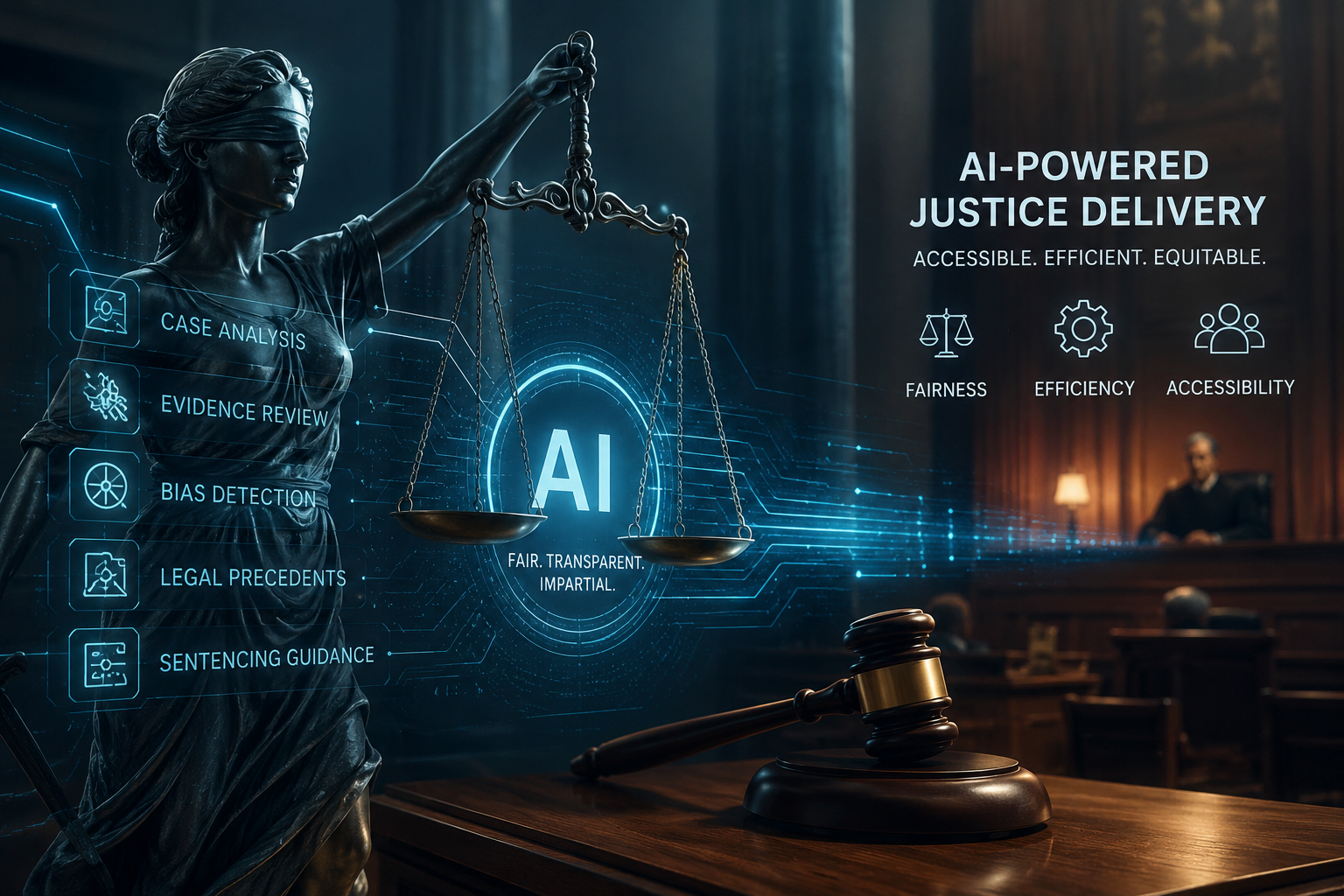
Regulations for use of AI in Courts
Released on June 3, 2026, India’s Supreme Court published draft Regulations for Use of Artificial Intelligence in Courts, 2026, inviting public comments until June 20. Prepared by the Court’s AI Committee, these regulations establish India’s first comprehensive framework for AI adoption across the entire judicial system — from the Supreme Court down to tribunals and statutory commissions.
Core Governing Principles (Chapter II)
Human primacy and judicial independence sit at the foundation. Every AI system must operate in an assistive capacity only; final authority on law, fact, and justice rests exclusively with judges. No AI output can substitute for independent judicial reasoning.
Fairness and non-discrimination requires that AI systems be trained and deployed in ways that avoid perpetuating bias on grounds of race, religion, caste, sex, gender, disability, language, or economic status, with special protection for vulnerable groups.
Transparency and explainability means every AI system must be capable of explaining its outputs in terms understandable to judges, parties, and the public. Opaque “black box” systems face heightened scrutiny in high-risk applications.
Accountability places full responsibility for AI-assisted decisions on the human officer involved. Citing AI opacity or “hallucination” as a defence for a harmful decision is expressly prohibited.
Data protection and privacy requires compliance with India’s Digital Personal Data Protection Act, 2023, with sensitive judicial data accorded the highest level of protection and the principle of data minimisation applied at every stage.
Proportionality calibrates AI use to the risk profile of the task — higher-risk matters (affecting personal liberty) require mandatory Human-in-the-Loop oversight and independent review.
Inclusivity and accessibility ensures AI does not widen digital divides, with equitable access extended to rural, economically disadvantaged, and linguistically diverse communities.
Innovation over restraint positions AI as a positive force for justice delivery, with responsible adoption actively encouraged — not blocked — subject to the other principles.
Permitted Uses of AI in Courts (Chapter III)
The regulations list permissible uses that are illustrative, not exhaustive, and require prior written approval:
- Case management, cause-list preparation, and docket prioritisation
- Automated transcription (with mandatory human certification)
- Translation of judgments, pleadings, and legal documents (with human verification)
- Legal research, precedent retrieval, and citation verification
- Administrative functions: case filing assistance, defect scrutiny, record management
- AI chatbots and conversational assistants to help litigants understand procedures
- Accessibility services (text-to-speech, Braille translation) for persons with disabilities
- Document authenticity verification and fraud detection (with mandatory human review)
- Anonymisation of judgments for public publication
- Performance analytics and backlog monitoring
Absolute Prohibitions on AI Use (Chapter III, Regulation 20)
These nine prohibitions are non-derogable — no authority, including the Chief Justice, can relax them:
- Using personal data to train AI without approval
- Reaching any judicial outcome through algorithmic decision-making alone
- AI performing adjudication or sentencing without mandatory human oversight
- Risk scoring for bail eligibility, recidivism prediction, flight risk, or witness credibility
- Using opaque or unexplainable AI where a person’s liberty or legal rights are affected
- Profiling or predicting future conduct of accused, witnesses, or advocates
- Surveillance of judges, lawyers, or litigants within or around court premises
- Submitting AI-generated output as independent evidence without full disclosure
- Using AI in any way that compromises the confidentiality of judicial deliberations
Institutional Framework (Chapter IV)
An Apex Body at the Supreme Court — comprising Supreme Court judges, High Court Chief Justices, and experts in technology, cybersecurity, finance, and data privacy — sets national standards and oversees implementation. It is supported by five specialist committees: Judicial, Technical, Infrastructure and Finance, Case and Data Management, and Cyber Security.
A Centre of Research and Excellence on AI (CoRE-AI) conducts original research, evaluates AI tools, and monitors international jurisprudential developments.
Each High Court constitutes its own AI Committee to approve, monitor, and audit AI systems within its jurisdiction. An AI Secretariat headed by a District Judge-level officer handles day-to-day operations, approvals, and incident management.
Oversight, Audits, and Transparency (Chapter V)
Before any AI system is deployed, a comprehensive Technical and Ethical Impact Assessment must evaluate its architecture, training data quality, bias risks, cybersecurity vulnerabilities, and explainability mechanisms.
All AI systems must undergo periodic audits at least annually, conducted in-house (source code and datasets cannot be shared with third parties for external auditing). An AI Register publicly documents every approved system, its approved scope, service provider, and audit history.
An AI Incident Database systematically records all malfunctions, errors, and biases. Incidents must be reported immediately, with cross-court learning shared between High Courts and the Apex Body. Every court must maintain an emergency and fall-back protocol for AI failure.
Parties must be informed when AI materially assists in their proceedings. Anyone submitting AI-generated content to a court must disclose that fact via a prescribed declaration or certificate.
Private Sector Engagement (Chapter VI)
No private vendor may provide AI services to courts without prior written approval. All contracts must include: data ownership protections, prohibition on retraining models with court data, mandatory indemnity clauses, on-premise or sovereign cloud deployment for sensitive data, and clear liability allocation for AI-related harm. Courts retain ownership (or a perpetual licence) of any AI tool built using judicial data or public resources.
Data Protection and Cybersecurity (Chapter VII)
Sensitive judicial data cannot be transferred to any external system without express authorisation. Data minimisation, anonymisation, and least-privilege access principles apply at every stage. Annual cybersecurity audits are mandatory.
Capacity Building and Grievance Redressal (Chapters VIII & IX)
All judges, advocates, and court staff must receive structured training on AI’s capabilities, limitations, bias identification, data protection, and incident reporting. Training must be accessible to district courts and linguistically diverse populations.
Any party harmed by a prohibited AI use may file an application directly to the court where the AI system was used. Other remedies under applicable law remain unaffected.
Key Takeaway
India’s draft AI court regulations strike a deliberate balance: actively encouraging innovation and AI adoption for efficiency and access to justice, while drawing hard lines around human judicial authority, non-discrimination, transparency, and data privacy. The comment period closes June 20, 2026 — submissions may be sent to office.regcc@sci.nic.in.