
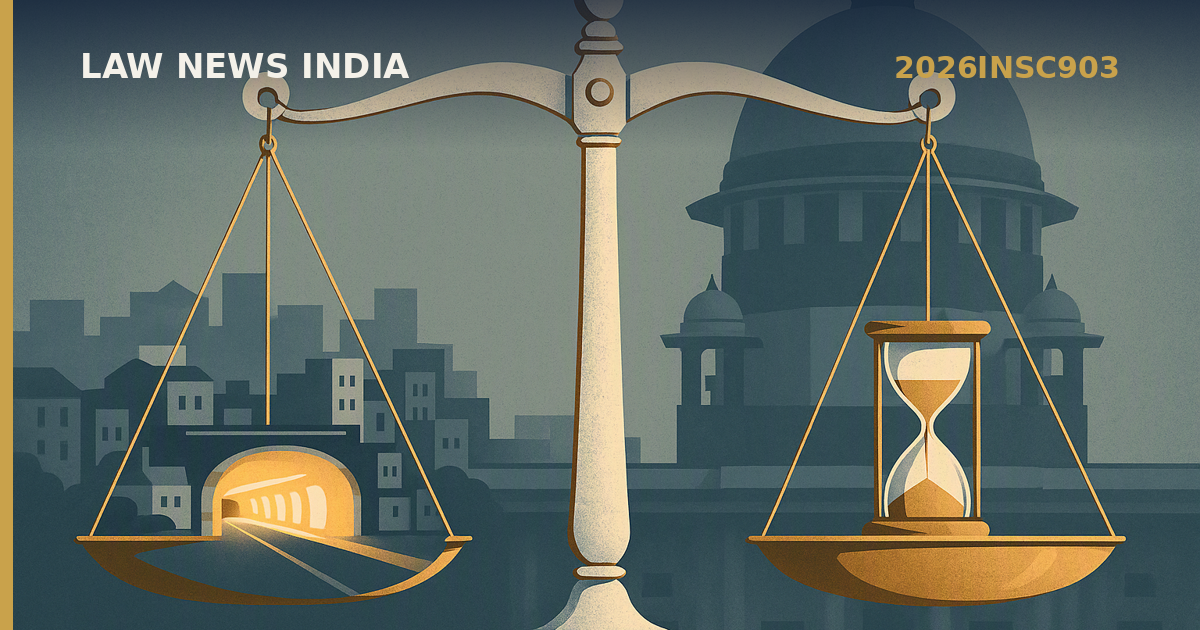
Madurai Farooq Ahmed v. The Principal Secretary to Government & Ors. — 2026 INSC 903 (21 August 2026)
What the case was about
For nearly two decades, Level Crossing No. 81 at Vaniyambadi in Tamil Nadu has stood as a daily bottleneck and a physical barrier, splitting the town and forcing a substantial number of residents to cross a busy railway line simply to move between its eastern and western halves. The crossing is not merely an inconvenience; it is a persistent safety concern and a stark reminder of how infrastructure promises can outlast entire political cycles without breaking ground. Since 2007, the Government of Tamil Nadu and Southern Railway have considered successive proposals to replace the crossing with a grade-separated structure—first a Road Over Bridge, then a Road Under Bridge, and finally a Limited Use Subway. Land acquisition proceedings were initiated under the Tamil Nadu Highways Act, 2001, yet the project remained trapped in a cycle of reconsideration and delay.
Frustrated by the paralysis, local resident Madurai Farooq Ahmed approached the Madras High Court in 2025 seeking directions to expedite the Limited Use Subway and complete it within a fixed timeframe. The High Court, by its judgment dated 25 July 2025, declined to keep the petition pending for continuous monitoring and disposed of the matter. The appellant then carried his challenge to the Supreme Court, raising a dilemma that resonates far beyond Vaniyambadi: when public authorities offer assurances about long-pending infrastructure, should a constitutional court trust those promises and step back, or retain the case to supervise every step?
The key facts
The railway line at Vaniyambadi is more than steel and track; it is a daily partition in the life of the town. Level Crossing No. 81 is heavily used, yet successive governments have struggled to move from proposal to execution. Since 2007, the plan has shifted from an overbridge to an underbridge, and finally to a Limited Use Subway, but the core obstacle remained the same—progress was glacial. The appellant, however, was no stranger to this fight. His earlier litigation had already succeeded in reopening the closed crossing for public use. When the subway scheme, too, seemed destined for indefinite delay, he returned to court. Before the Supreme Court, the State authorities and Southern Railway placed on record comprehensive statements detailing the current status of land acquisition, the tender process, and the prospective timeline for execution.
The questions before the Court
A Bench of Justices Vikram Nath and Sandeep Mehta framed two questions for decision. First, was the Madras High Court justified in disposing of the writ petition without issuing time-bound directions for the construction of the Limited Use Subway? Second, should the Supreme Court keep the appeal pending merely to act as a continuous monitor of the project’s execution, or could it accept the government’s assurances and close the case while holding the authorities to strict accountability?
What the Court decided and why
The Supreme Court held that the High Court’s disposal did not warrant interference. Crucially, the respondents had placed “definite statements and assurances” before the Court regarding timelines, and the material showed that the undertaking had finally moved beyond the stage of mere consideration. “The project, which has remained under consideration in one form or another for a considerable period of almost 20 years, has now progressed materially towards execution,” the Court noted, taking the respondents’ commitments on record and expecting the authorities to proceed “with due expedition and in coordination with each other” (para 9).
Accepting these assurances as sufficient, the Bench held that “no useful purpose would be served by keeping the present appeal pending merely for the purpose of continuously monitoring the execution of the project,” and directed that the respondents’ statements would be duly complied with (para 12). But the Court did not simply step away; it transformed the undertakings into judicially enforceable directives. The State authorities were directed to complete pending land acquisition proceedings and all other approvals with utmost expedition, ensuring that the requisite land is made available to Southern Railway without avoidable delay. Southern Railway, in turn, was directed to finalise its tender process and, upon award of the contract and availability of the requisite land, to complete its portion within six months. Simultaneously, the State authorities were ordered to proceed with designs, estimates, administrative approvals, and other necessary steps for the highways portion so that the work could advance in parallel without further avoidable delay (para 14). To ensure accountability, both the State and Southern Railway must file compliance affidavits before the Court, in any event within eight months from the date of judgment, setting out the steps taken in pursuance of the directions (para 15).
In an equally significant passage, the Court paused to acknowledge the appellant himself. Noting that writ courts are often flooded with public interest petitions that, upon scrutiny, advance no genuine public cause, the Bench said this matter “stands on a different footing.” It observed that the appellant had demonstrated how “a vigilant and bona fide citizen can, through sustained and responsible engagement with public authorities and constitutional courts, draw attention to an issue affecting the community at large,” adding that “such constructive civic participation deserves acknowledgment” (para 11).
Why it matters
For Vaniyambadi’s residents, the ruling turns nearly twenty years of administrative inertia into a concrete, time-bound roadmap. By accepting government assurances only after crystallizing them into fixed deadlines and a mandatory compliance mechanism, the Court has struck a pragmatic equilibrium: it has resisted the temptation to become a permanent project-supervisor, while ensuring that public authorities remain firmly bound by the commitments they made on the judicial record.
The judgment also carries a wider message about democratic accountability. In an era of crowded court dockets and growing skepticism toward public interest litigation, the Supreme Court’s explicit recognition of one citizen’s patient, community-focused advocacy is a powerful signal that constitutional remedies remain alive for those who engage with the state sincerely and persistently. The ruling offers a template for other long-pending public works stuck in similar cycles of sanction and stagnation, clarifying that judicial oversight does not require perpetual pendency so long as authorities are locked into explicit, time-bound undertakings backed by sworn compliance reports. For communities divided by railway lines and bureaucratic delay, the decision is a reminder that a single vigilant voice can still help build the crossing that everyone had stopped expecting.