
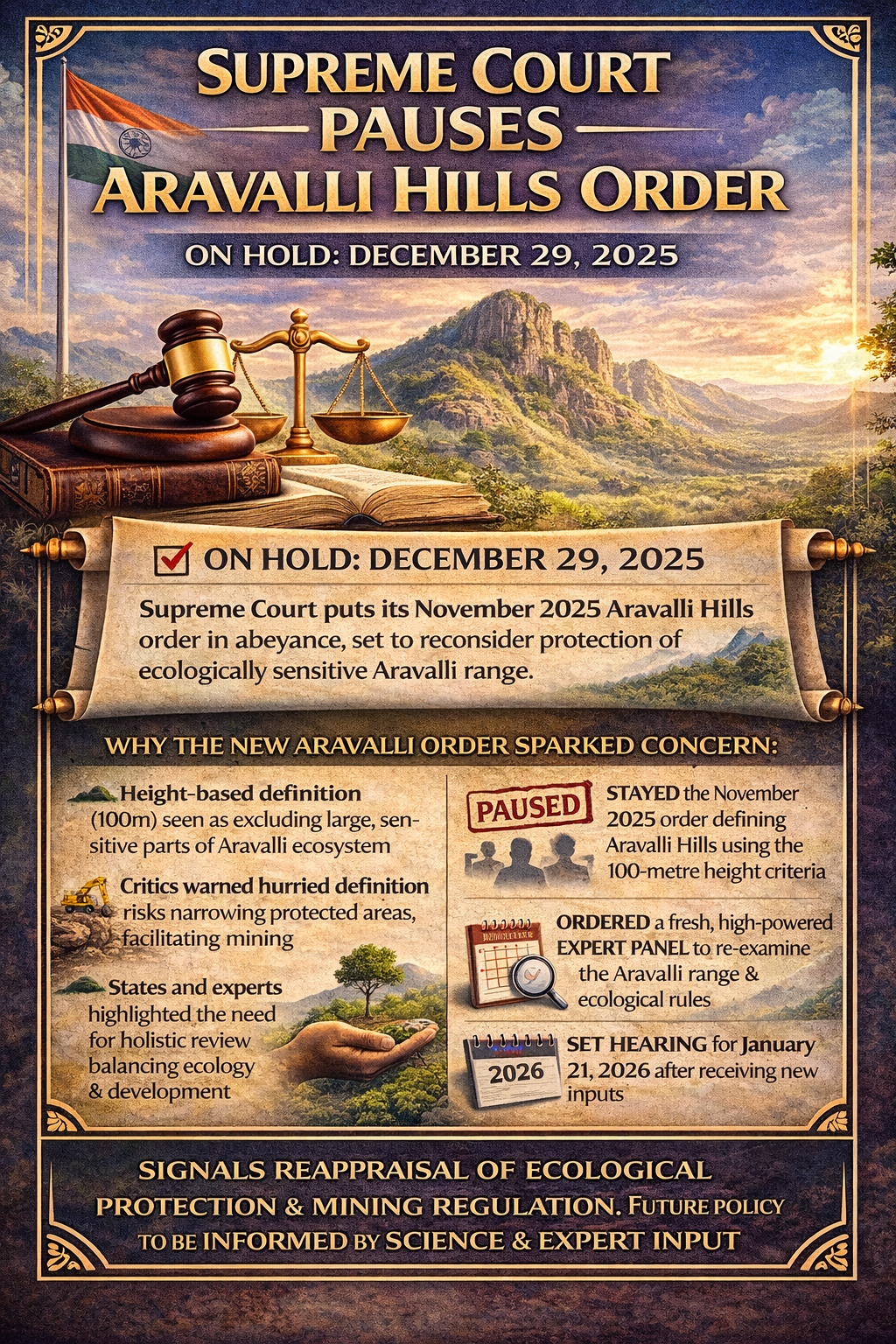
Supreme Court of India | Aravalli Hills Case | December 29, 2025
The Supreme Court of India, in a significant development on 29 December 2025, has put in abeyance its earlier judgment dated 20 November 2025 concerning the definition and regulation of the Aravalli Hills and Aravalli Range. The Court also indicated that the issue requires fresh expert evaluation, given its far-reaching environmental and developmental consequences.
Background: The November 20 Aravalli Hills Judgment
In its November 20, 2025 ruling, the Supreme Court had adopted a uniform scientific definition of the Aravalli Hills and Range, including a criterion that landforms rising 100 metres above the surrounding terrain could qualify as part of the Aravalli system.
This definition was intended to bring clarity to environmental regulation and mining restrictions but soon triggered widespread concern among environmentalists, state governments, and stakeholders.
What Did the Supreme Court Order on December 29, 2025?
On December 29, 2025, a Bench led by the Chief Justice of India stayed the implementation of its November judgment and issued the following key directions:
Key Highlights of the Latest Supreme Court Order
- The November 20, 2025 Aravalli Hills judgment has been kept in abeyance.
- The 100-metre height-based definition will not be implemented for now.
- The Court proposed the constitution of a high-powered expert committee to re-examine:
- The ecological continuity of the Aravalli range
- The adequacy and impact of the earlier definition
- Potential consequences for environmental protection and mining regulation
- Notices were issued to the Union Government and Aravalli-bearing states including Delhi, Haryana, Rajasthan, and Gujarat.
- The matter has been listed for further hearing in January 2026.
Why Did the Supreme Court Pause Its Own Judgment?
The Court acknowledged that several complex environmental and scientific issues required deeper examination. Concerns were raised that the earlier definition might:
- Exclude large ecologically sensitive areas from protection
- Dilute long-standing safeguards against mining and construction
- Lead to inconsistent environmental outcomes across states
By placing the judgment in abeyance, the Supreme Court signalled a cautious and consultative approach toward environmental governance.
Legal and Environmental Significance
The December 29 order is significant because it:
- Demonstrates judicial self-correction in matters of environmental importance
- Reinforces the role of expert-driven decision-making in ecological disputes
- Maintains the status quo on Aravalli protection pending further review
- Highlights the Court’s sensitivity to balancing developmental needs and environmental conservation
What Happens Next?
The proposed expert committee is expected to play a central role in shaping the future course of the case. The Supreme Court will revisit the matter after receiving inputs from experts and stakeholders, potentially leading to a more nuanced and sustainable framework for Aravalli Hills protection.
Conclusion
The Supreme Court’s latest order on the Aravalli Hills case underscores the complexity of environmental adjudication in India. By pausing its earlier ruling and seeking expert guidance, the Court has reaffirmed that environmental protection must be grounded in science, inclusivity, and long-term sustainability.
SEO Keywords (strategically embedded)
- Supreme Court Aravalli Hills order
- Aravalli Hills Supreme Court judgment
- SC order on Aravalli Hills December 2025
- Aravalli Hills definition Supreme Court
- Environmental law Supreme Court India
- Mining and Aravalli Hills case