
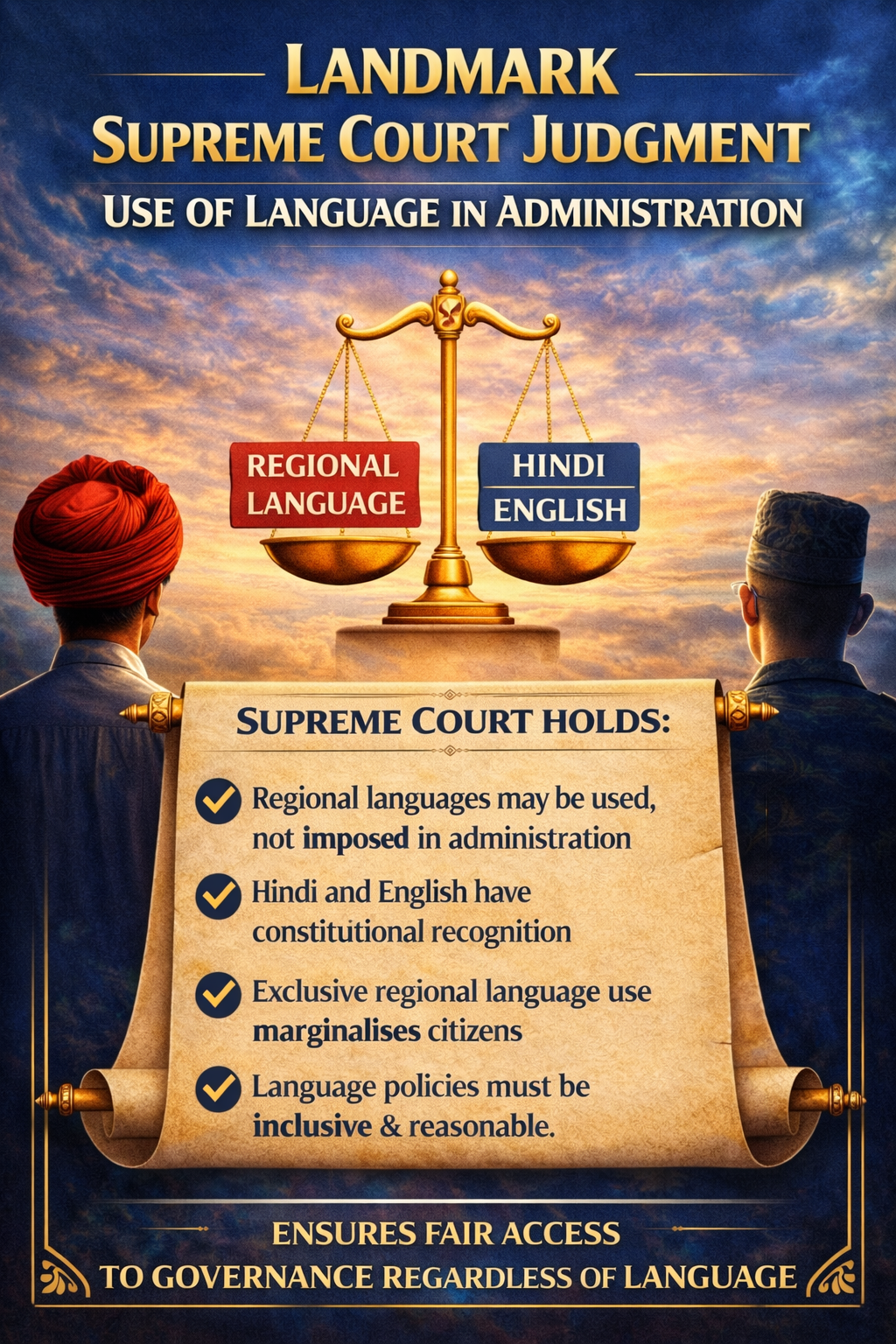
In a significant judgment delivered in 2025, the Supreme Court of India clarified the constitutional framework governing the use of language by State governments in official administration. The Court held that while States enjoy autonomy in adopting regional languages, such usage cannot exclude, marginalise, or disadvantage citizens who are entitled to communicate in constitutionally recognised languages.
Key Findings of the Supreme Court
- Regional languages may be used for official purposes by States under Articles 345 and 346 of the Constitution.
- However, exclusive or rigid insistence on a single regional language in administration, recruitment, or governance violates constitutional equality if it restricts access to public services.
- The Court reaffirmed that Hindi and English continue to enjoy constitutional recognition for official communication where applicable.
- Language policies must be inclusive, reasonable, and non-discriminatory.
Constitutional Principles Applied
- Article 14 (Equality before law): Language cannot become a tool of exclusion.
- Article 19(1)(a): Freedom of expression includes linguistic choice.
- Article 21: Access to governance and justice must not be impaired by language barriers.
- Articles 343–351: Scheme governing official languages must be interpreted harmoniously.
Legal Significance
- Prevents linguistic discrimination in public employment, examinations, and administration.
- Reinforces India’s linguistic diversity while maintaining national unity.
- Serves as a guideline for States framing language policies, recruitment rules, and administrative circulars.
- Protects citizens from being denied services due to lack of proficiency in a particular regional language.
Why This Judgment Is Landmark
This ruling is landmark because it:
- Balances federal autonomy with individual rights.
- Reaffirms that language policy is a facilitative tool, not a gatekeeping mechanism.
- Strengthens constitutional values of inclusiveness, accessibility, and equality in governance.
Conclusion
The Supreme Court’s language-use judgment underscores that while India celebrates linguistic plurality, governance must remain accessible to all citizens, irrespective of their linguistic background.
SEO Keywords (naturally embedded)
- Supreme Court language use judgment
- Official language policy Supreme Court
- Language discrimination in administration India
- Articles 343–351 Constitution of India
- Regional language governance Supreme Court